Most students visit a college once, sit with a counsellor for twenty minutes and leave with a brochure. The labs are modern, the faculty are experienced, the placements are strong. Every college says the same things, so the words tell you very little.
Questions with checkable answers work better. If you are searching for the best aviation college in Chennai, or comparing aviation colleges in Chennai on a shortlist, these are the ones worth asking. The examples come from HIET (Hindustan Institute of Engineering and Technology), so you can see what a clear answer looks like.
- Is the Aviation Institute in Chennai Approved by the DGCA?
Start here, because everything else depends on it. AME training that counts towards your licence has to come from an institute approved under the DGCA’s CAR 147. At an unapproved aviation training institute, you could finish the course and hold a certificate that does not count towards your licence.
Ask to see the approval certificate and check which categories it covers. HIET has been approved under CAR 147 (Basic) since 2018 for Category B1 (mechanical) and B2 (avionics), and since 2022 for B1.3 (helicopter turbine). The approval certificate, validity and schedule pages are on its website, so you can read them before you visit.
- Am I Eligible, and What Do I Need to Bring?
For AME at HIET you need Class 12 with Physics, Chemistry and Mathematics, or an engineering diploma that includes those subjects. The FAQ page sets the minimum at 40% in Class 12 and the minimum age at 17. Classes are in English.
The medical catches people out. You need a fitness certificate from a doctor and a colour vision certificate from an eye specialist, and the college expects no colour blindness or vision defect. Get this done before you pay any fees. Keep your mark sheets, transfer certificate, photographs and ID copies ready as well.
- Which Course Fits, and How Long Does It Run?
HIET offers three AME categories. B1.1 (aeroplane turbine) and B2 (avionics) run for two and a half years, and B1.3 (helicopter turbine) runs for two. Students can also take a B.Sc in Aircraft Maintenance Engineering or in Avionics alongside, which takes three years, with the degree coming from Hindustan Institute of Technology and Science.
Find out how the time is split. At HIET, 30% of the training happens at an approved maintenance organisation or an airline, and the rest is in-house theory and practicals. Whichever aviation colleges in Chennai you are comparing, that split shows how hands-on the course really is.
- What Are the Attendance and Pass Rules?
Students skip this one and regret it. HIET asks for 90% attendance in every semester and a minimum of 75% to pass each subject. Each semester has five subjects. Both numbers are higher than most people expect from a college course. Every institute has its own rules, so get them in writing, and find out what support there is for students who fall behind.
- What Will I Actually Train On?
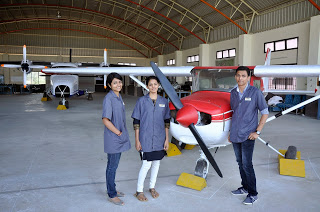
A training hangar shows what an aviation training institute has invested in. HIET’s Aero Hangar covers 9,000 sq ft and can hold six Cessna 152 or 172 aircraft. It also has a Dornier, a LearJet 24D, a Robinson helicopter, gas turbine engines, 14-cylinder radial engines and a low-speed wind tunnel. Separate workshops cover piston engines, jet engines, hydraulics and landing gear, with labs for avionics, instruments and radio navigation.
Put the same questions to all the aviation colleges in Chennai on your list. Which aircraft, which engines, and how many students share them? Then ask to walk through the hangar. A photo gallery cannot answer any of this.
- What Will It Cost, and What Is Extra?
Fees are where the surprises sit. HIET publishes its tuition fees for each year of the course, and says the AMO practical training fee is paid in addition. Tuition can be paid in two instalments a year, and students can apply for education loans. At any aviation institute in Chennai, check what the quoted fee leaves out.
Look at scholarships as well. HIET lists concessions for students with 85% or more in Class 12, children of ex-servicemen, sportspersons, first-generation graduates, female students, and siblings and alumni. Only one scholarship can be claimed.
- Where Do Graduates Actually Work?
Placement percentages tell you little. Names tell you more. Ask any aviation training institute which airlines and maintenance organisations have hired from recent batches, and whether they come to the campus.
HIET lists alumni at Air India, IndiGo, SpiceJet, Emirates, Qatar Airways and Cathay Pacific, among others, and says over 5,000 of the 47,000 engineers and technicians it has trained now work with airlines and aviation industries in India and abroad. It has MoUs for practical training with AI Engineering Services Limited, Blue Dart Aviation, GMR, Deccan Charters and Orient Flights. In March 2026, Air India ran the selection process for its AME Cadet Program on the campus, and around 19 students took part. HIET also posts its DGCA module results on its website, which is worth asking every college to match.
Choosing the Best Aviation College in Chennai
There is no single best aviation college in Chennai for everyone. The right one has a current approval, eligibility and fees written down, a hangar you can walk through and placement answers that come with names. Visit more than one aviation institute in Chennai, put the same questions to each, and compare the answers side by side.
HIET’s campus is at Padappai, on the highway connecting Tambaram and Oragadam, about 15 km from Tambaram railway station, and a hostel facility is available. For admissions, call 96000 07444 or write to ameadmission@hiet.in. Course, fee and eligibility pages are at www.hiet.in.