There’s a version of this decision that most students make without thinking about it. They pick a college based on the fee structure, or because a relative suggested it, or simply because it was the first result that came up when they searched for aviation colleges in Chennai. They don’t think much about where the college is, what’s around it, or what kind of industry access it actually provides.
That approach works out fine for some courses. For aviation, it’s a mistake.
Aviation is an industry where what you’re exposed to during training has a direct bearing on how prepared you are when you enter it. The college you choose and where it sits matters more than it does in most other fields. Here’s why.
Chennai Isn’t Just a City With an Airport
Every major Indian city has an airport. Not every city has the depth of aviation infrastructure that actually makes a difference to students who are training in it.
Chennai sits in a different category. The city has MRO facilities, active airline operations, aerospace manufacturing presence, and defence aviation activity. These aren’t background details. They are the industry ecosystem that determines whether an aviation training institute can offer students real exposure or whether everything stays theoretical.
When a college has proximity to active MRO facilities, students can do industry visits that mean something. When airlines are operating nearby, there are actual internship and placement pathways rather than vague promises about industry connections. When defence aviation is part of the local landscape, it opens career directions that aren’t available from every city.
This is what people mean when they talk about location mattering for aviation education. It isn’t about the city being convenient to live in. It’s about whether the industry you’re training to enter is actually accessible from where you’re studying.
The Gap Between Training and Industry Readiness
Here’s something the brochures don’t say clearly enough: there is a significant difference between completing an aviation course and being industry-ready.
A student who has spent their training years working on actual aircraft systems, visiting MRO facilities, understanding how a maintenance organisation functions, and interacting with working professionals arrives at their first job in a completely different state of readiness than one who learned everything from textbooks and diagrams.
This gap isn’t about intelligence or effort. It’s about exposure. And exposure is almost entirely a function of where you trained and what your institution made available to you while you were there.
Aviation training institutes in Chennai that have built genuine relationships with local industry, that organise regular site visits, that bring in practitioners as part of the learning experience, and that use the city’s aviation ecosystem actively are giving their students something that cannot be replicated in a classroom. The ones that don’t are leaving students to figure out the gap themselves, usually after they’ve already graduated.
What Industry Access Actually Looks Like in Practice
This is worth being concrete about, because “industry exposure” is another phrase that appears in every brochure without meaning much on its own.
Real industry access during an aviation programme looks like this. Students visit MRO hangers and see how a licensed maintenance organisation actually operates, how work orders are raised, how documentation flows, how a team of engineers coordinates on an aircraft. They see the difference between textbook procedures and how those procedures function in a commercial environment with time pressure and regulatory accountability.
It looks like guest sessions with working AMEs and avionics engineers who can talk about what the job actually involves, what the DGCA licensing process felt like from the inside, and what they wish they’d understood better when they were training.
It looks like internship placements where students are in an actual aviation environment rather than a simulated one, building hours that count and developing the professional judgment that only comes from being in a real workplace.
The best aviation colleges in Chennai build all of this into the programme systematically rather than treating it as an occasional bonus.
How Location Shapes Placement Outcomes
The connection between where you study and where you end up working is more direct in aviation than in most fields.
Airlines, MRO companies, and airport operators hire from institutions they know. They hire from programmes whose graduates they’ve seen perform well. They hire from colleges that their own employees trained at. These relationships build up over years and they’re geographically concentrated.
An aviation institute in Chennai that has been producing graduates for a significant period, that has alumni working at recognisable organisations, and that has maintained relationships with local employers is a fundamentally different proposition from a newer institution or one based somewhere with thinner industry presence.
When you’re evaluating aviation colleges in Chennai, ask specifically about where recent graduates are working. Not the percentage on the website, but the actual names of organisations and the kinds of roles people are in. That information tells you far more about placement outcomes than any headline statistic.
The Defence and Aerospace Angle
Chennai’s aviation ecosystem includes more than commercial aviation. The presence of defence aerospace organisations and manufacturing in the broader region means that AME graduates and avionics specialists have career pathways that extend beyond airlines and MRO.
Defence aviation operates under different regulatory frameworks, but the technical foundation built through a DGCA-aligned AME programme transfers across. Students who are aware of this during training, who understand what these organisations look for and how to position themselves for those roles, have a wider set of options at graduation than students for whom this was never part of the conversation.
An aviation training institute that operates in an ecosystem where these options exist, and that prepares students to access them, is offering something genuinely broader than one focused only on commercial airline careers.
HIET in Chennai
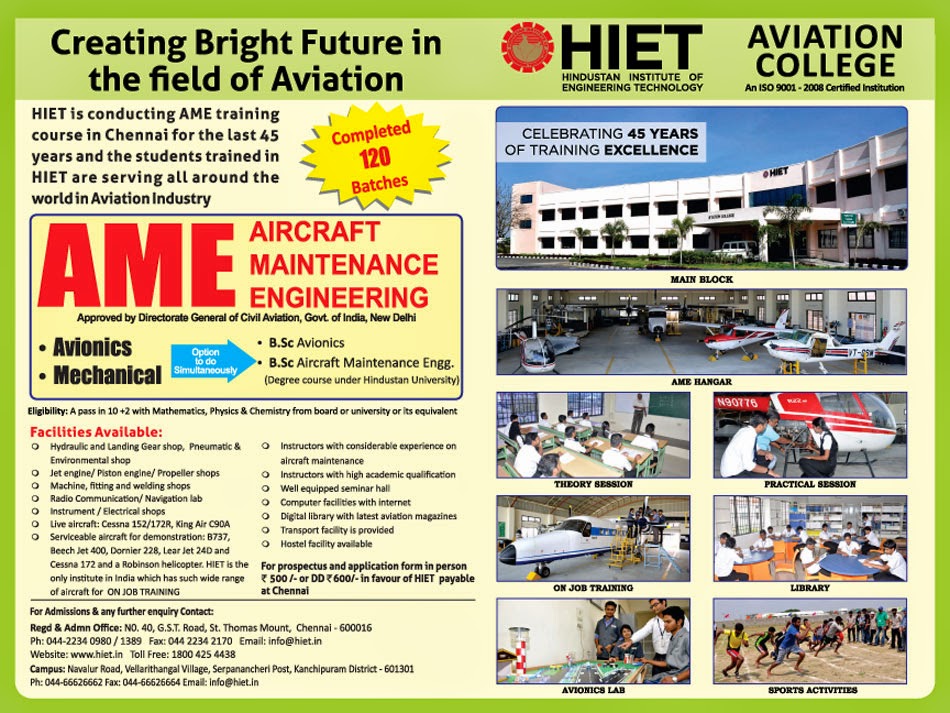
Hindustan Institute of Engineering and Technology has been training aviation students in Chennai long enough to have built the kind of industry relationships and placement track record that actually mean something.
The location gives students access to Chennai’s aviation ecosystem. The DGCA-approved AME programmes are structured around the licensing pathway rather than being a general engineering degree with aviation content added on. The practical training is built into the curriculum, not treated as a finishing touch.
If you’re making a serious decision about aviation education in Chennai, the starting point is www.hiet.in. Go in person, see the facilities, and ask the questions that actually matter.
The Bottom Line
Chennai gives you something that most cities in India simply can’t match for aviation education: a live industry ecosystem that you can be part of during your training years, not just after them.
Whether you make use of that depends on which institution you choose and how seriously it takes the responsibility of connecting students to that ecosystem.
That’s the decision worth getting right.