Every year, somewhere around Class 10 or Class 12 results, the same conversation happens in homes across Tamil Nadu. The future has arrived, or at least the question of it has, and nobody has a clean answer ready. Everyone means well. Some point toward degree programmes. Some say a diploma is fine. Some just repeat what worked for a cousin a decade ago.
What gets talked about least is the one thing that would actually help: what each diploma stream involves, where it leads, and which one fits the specific person trying to decide.
This is an honest attempt at that conversation.
Mechanical Engineering: The Discipline That Gets Into Everything
There’s a reason the diploma in mechanical engineering has been one of the most consistently sought-after qualifications in India for decades. Mechanical engineering is not a niche field. It is, in some form, present in almost every industry that makes or moves something.
Manufacturing, heavy engineering, energy production, defence, infrastructure, aerospace, the list of sectors where a DME mechanical engineering qualification opens a genuine door is long and genuinely varied. What makes it valuable is not just what it covers, but how transferable that coverage is. A graduate who understood their mechanical engineering diploma well isn’t locked into one industry or one kind of role. They have the technical foundation to function across a wider range of environments than most specialised qualifications allow.
The career trajectory for a mechanical diploma graduate typically begins on the workshop floor or in a technical support role, and that’s not a bad place to start. The people who understand manufacturing or maintenance at the operational level, not just from a management distance, tend to rise through organisations with more authority behind them than those who arrived at the top without that grounding.
PSU examinations, railways, defence recruitment, and state public works departments also absorb mechanical diploma graduates in meaningful numbers. For students who want a qualification that connects directly to stable employment across both private and public sectors, a diploma in mechanical engineering continues to deliver on that.
Automobile Engineering: Right in the Middle of a Transformation
The automobile industry is changing faster than almost any other. Electric vehicles are moving from conversation to reality. Vehicles are being defined increasingly by software. Advanced driver assistance, connected systems, over-the-air updates, these are not features on the horizon. They are features on cars available in India right now.
This doesn’t make an automobile diploma course less relevant. If anything, it makes the people who genuinely understand the industry more necessary, because the transformation is complex and the skill gap is real.
The foundation of a diploma in automobile engineering remains what it has always been: powertrains, chassis, braking and suspension systems, transmission, vehicle dynamics. Those fundamentals aren’t going away. The physical systems of a vehicle still exist and still need engineers who understand them. But the graduates entering the industry today need to understand that those systems now live alongside electronic control units, sensor arrays, and communication architecture that changes how everything behaves.
Career pathways from a well-structured diploma in automotive engineering include vehicle manufacturing, dealership service and aftersales, fleet and transport operations, EV servicing infrastructure which is growing quickly, and the spare parts and aftermarket sector which employs large numbers of automobile engineers across India. The two-wheeler market alone is among the largest in the world, and the commercial vehicle sector adds substantially to that employment base.
For students who find vehicles genuinely interesting, not just as a career category but as things they actually want to understand and work on, an automobile diploma course at a good institution puts them where the action is.
Computer Engineering: The Widest Door in the Building
Choosing a diploma in computer engineering used to mean choosing a path into software or IT support. That’s still true, and both remain large and active areas of employment. But the scope of what a computer diploma opens now is considerably wider than it was even five years ago.
Cybersecurity has become a major field in its own right, driven by the real and growing threat of digital attacks across every sector. The shortage of people who understand security at a technical level is acute, and it isn’t going away. Cloud computing and infrastructure management are absorbing engineers at scale as businesses shift their operations online. Data pipelines, analytics systems, and the tooling around machine learning all have entry points for technically grounded diploma holders who’ve developed the right foundations.
This makes the diploma in computer engineering unusual in one specific way: the industries hiring its graduates are more varied than almost any other diploma stream. IT services companies, banks and financial institutions, manufacturing companies with digital operations, government technology departments, e-commerce, healthcare, the list crosses sectors in a way that mechanical or automobile engineering simply doesn’t.
The observation that comes up most consistently from employers in this space is about evidence. A computer diploma graduate who can show something they’ve actually built, an application, a project, a working system, has a distinct advantage over someone who can only describe what they studied. Good programmes create the conditions for students to build things during their course, not just after it. That’s the detail worth looking for when comparing institutions.
Electronics and Electrical Engineering: The Invisible Infrastructure of Everything
Power doesn’t generate itself. Industrial machinery doesn’t control itself. Telecommunications infrastructure doesn’t maintain itself. All of it depends, somewhere in the chain, on people who understand electrical and electronic systems well enough to build, maintain, and improve them.
The diploma in electronics and electrical engineering sits at the centre of industries that are both foundational and actively growing. Power utilities, renewable energy installations, industrial automation, control systems engineering, electronics manufacturing, telecommunications, EEE graduates have a spread of employment options that reflects how fundamental their discipline actually is.
The energy transition is creating specific demand that didn’t exist a decade ago. Solar installations, wind energy systems, battery storage, smart grid technology, all of it requires engineers who understand electrical systems at a practical level, and India is building this infrastructure at scale. A student entering a diploma in electronics and electrical engineering today is qualifying into a labour market where their skills are increasingly needed, not just historically valued.
What gets underappreciated about EEE is the overlap with other sectors. Modern industrial machinery runs on electronic control systems. Modern vehicles have electrical architectures that grow more complex with every generation. Graduates who understand how their discipline intersects with mechanical and automotive engineering have flexibility in the job market that pure specialisation doesn’t always give you.
After 10th or After 12th: Does the Entry Point Matter?
Both pathways exist for a reason.
Students who pursue a diploma after Class 10 commit three years to a stream and enter the workforce earlier. It suits students who have a clear sense of what they want to do, who learn better in practical environments than in purely academic ones, and for whom an earlier start to a working career makes sense given their circumstances.
Students who come in after Class 12 bring an additional two years of academic foundation and typically take a more compressed diploma path. They often have a clearer sense of where they’re headed because they’ve had more time to figure it out.
Neither entry point is objectively better. Both lead to the same qualification and the same employment market. The difference is in timing, context, and what the student brings to it.
What matters more than the entry point is the quality of the programme and what happens during it. A diploma from a college that takes the practical component seriously, that has faculty who’ve worked in the relevant industry, and that prepares students for employment rather than just for examinations, will outperform a diploma from an institution that doesn’t, regardless of when the student started.
What Hindustan Institute of Engineering and Technology Offers
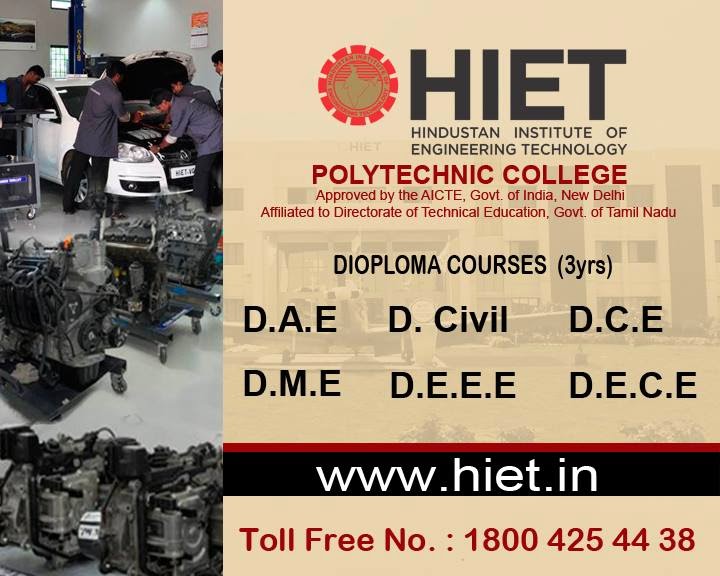
At Hindustan Institute of Engineering and Technology (HIET), all four of these diploma programmes are offered with the same underlying philosophy that runs through everything we do. Faculty who come from the industry, not just from academia. Practical training that begins early in the programme rather than arriving as an afterthought at the end. And a consistent focus on producing graduates who are genuinely ready for the workforce.
The diploma in mechanical engineering at HIET gives students real workshop exposure from early in the course. The automobile diploma course connects students to actual vehicle systems, not just the theory of them. The diploma in computer engineering includes structured project work because we believe employers should be able to see what our graduates can build. And the diploma in electronics and electrical engineering puts students in contact with control systems, power equipment, and instrumentation that reflects what they’ll actually encounter in the field.
If you’re weighing these options for yourself or for your child, the most useful thing we can offer isn’t a longer version of this article. It’s a genuine conversation about which path fits, and what the experience at HIET actually looks like. Come and ask.
Interested in any of HIET’s diploma programmes? Reach out to our admissions team and let’s figure out which one is the right fit.