The months after Class 12 results are some of the most disorienting of a young person’s life. Everybody has an opinion. Parents want stability. Friends are going in different directions. And somewhere underneath all of it, the student is trying to figure out what they actually want.
The three paths that come up most often are engineering degree programmes, polytechnic diplomas, and aviation courses. They sound similar enough to be confusing and different enough in practice to matter enormously. Here’s an honest look at each.
What an Engineering Degree Programme Actually Is
A four-year B.E. or B.Tech is academically intensive and opens doors in engineering industries, IT, R&D, government services, and postgraduate education. For students with a clear academic inclination and the patience for a longer runway before employment, it makes sense.
The honest challenge is that the first two years involve significant foundational science and mathematics that can feel far removed from the actual engineering work students came to do. For students who learn better in practical environments, or who want to be working sooner, the degree path can be a difficult fit.
It isn’t the wrong choice. It’s a specific choice, suited to a specific kind of student. The mistake is treating it as the default and measuring everything else against it.
What a Polytechnic Diploma Actually Offers
A polytechnic diploma is often dismissed as the choice you make when you couldn’t get into a degree programme. That dismissal reflects a real misunderstanding of what the diploma is for and what it produces.
It’s explicitly industry-oriented. The curriculum is tighter, the practical component is higher, and the path to employment is, for many graduates, faster and more direct than the degree route. Students who know they want to work with their hands and minds together, and who’d rather build expertise through doing than through years of abstraction, tend to thrive here.
Lateral entry is worth knowing about. Diploma holders can enter degree programmes in the second year, which means a diploma is not a ceiling. It’s a foundation, and students who take that path arrive with practical experience their classmates often don’t have.
What Aviation Courses Actually Involve
Aviation sits apart from both engineering and polytechnic paths in one important way: the specialisation itself is the qualification.
Aircraft maintenance engineering in India is governed by the DGCA. You’re not just studying for a certificate. You’re working toward a licence that the industry is built around. The work is demanding and precise, and the weight of responsibility is real. Maintenance engineers are the last line of assurance before an aircraft carries passengers. That accountability shapes everything about the culture of the industry.
For students drawn to aircraft and to a career with genuine international dimensions, aviation is not a lesser choice than engineering or a diploma. It’s a different one, with its own distinct rewards.
Aviation training in Chennai and across Tamil Nadu has grown considerably, but the quality of institutions varies. A student choosing an aviation training institute is making a decision that shapes not just their knowledge but their ability to obtain a licence and enter the industry. That decision deserves serious research.
How to Actually Think About the Three Paths
There is no objectively better path. There’s only the path that fits the specific student.
A few questions are worth sitting with honestly. How do you learn? Engineering degrees suit students who absorb well through reading and extended analysis. Polytechnic and aviation programmes suit students who need to touch things before concepts make sense. Neither is a flaw. But the fit matters.
How quickly do you need to be working? A four-year degree is a real financial and time commitment. A diploma or aviation programme shortens that timeline substantially. If family circumstances make a longer runway difficult, that’s a legitimate factor, not a failure of ambition.
What industry are you actually drawn to? Not the one that sounds impressive at a family gathering, but the one you find yourself reading about without anyone asking you to. That answer is worth trusting.
The Case for Aviation Specifically
The Indian aviation industry has been growing. Airport infrastructure is expanding. Aircraft fleets are being modernised. The demand for licensed engineers is real and ongoing. And aviation qualifications travel across borders in ways that most technical careers don’t, meaning the ceiling isn’t defined by the domestic market alone.
Chennai has a growing presence in aviation training. Aviation colleges in Chennai have expanded in range and capacity, and students in Tamil Nadu have options that earlier generations simply didn’t. But choosing the right aviation college in Chennai means looking past the prospectus. The institutions worth considering combine genuine hangar exposure with faculty who’ve worked in the field and a placement record that stands up to scrutiny.
What This Means if You’re Deciding Right Now
The most useful thing at this stage is not a comparison table. It’s a few hours of honest conversation. Talk to people working in each of these fields. Visit the institutions you’re considering seriously, not just for the official tour, but to talk to current students and see where the practical training actually happens.
And try, as much as possible, to separate your own instincts from the noise around you. The right choice is the one you’ll show up for every day with genuine engagement. That’s the one that produces a good outcome, whichever path it is.
Where HIET Fits Into This Picture
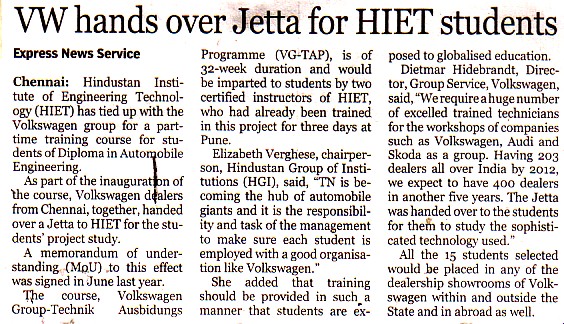
Hindustan Institute of Engineering and Technology (HIET) offers programmes across all three categories: engineering degrees, polytechnic diplomas, and aviation training, all with the same underlying approach. Faculty with industry experience. Practical training that begins early. A focus on graduates who are ready for the workforce, not just ready for the next exam.
For students drawn to aviation, HIET is among the established aviation colleges in Chennai, with a programme built around DGCA requirements and real aircraft exposure. For students considering polytechnic or engineering routes, the same philosophy runs through every discipline offered.
If you want to understand what each path actually looks like in practice, the most useful thing HIET can offer isn’t a brochure. Come and see. Talk to the team, visit the campus, and ask the questions the prospectus doesn’t answer.
Ready to figure out which path is right for you? Reach out to the HIET admissions team and let’s have an honest conversation about it.