In aviation, theory gets you started — but practical training and industry exposure are what truly shape a successful aircraft maintenance engineering career. Here’s why it matters more than most students realise.
There’s a moment every aviation student remembers.
The first time they step inside a real aircraft hangar.
It smells different. Sounds different. Feels different.
Textbooks don’t hum. Aircraft do.
And that difference — between reading about a system and standing next to it — is where careers begin to take shape.
If you’re researching aircraft maintenance engineering course details, or comparing aircraft maintenance engineering colleges, this is the part you need to understand clearly:
In aviation, practical exposure is not optional. It is foundational.
Aviation Is Not a Classroom Profession
Aircraft maintenance engineering is regulated, structured and technical — yes.
But it is also deeply physical.
An AME course teaches you aerodynamics, turbine engines, avionics systems and regulations. You’ll study manuals. You’ll prepare for DGCA modules. You’ll review diagrams.
But until you:
- Hold a torque wrench
- Trace wiring physically
- Interpret a live fault
- Walk through an actual maintenance bay
the learning remains incomplete.
This is why the quality of your aircraft maintenance engineering course environment matters far more than many students initially assume.
Why Practical Training Changes Everything
Let’s consider two hypothetical students.
Both complete an aircraft maintenance engineering course.
Both clear their DGCA modules.
Both graduate.
One has primarily classroom exposure.
The other has spent consistent hours in hangars, workshops and supervised maintenance environments.
When they walk into an airline interview, the difference is visible.
Confidence comes from familiarity.
Airlines don’t just evaluate marks. They evaluate comfort around aircraft.
Industry Exposure Builds Technical Instinct
Aircraft systems are interconnected.
Hydraulics influence control surfaces. Electrical systems interact with avionics. Engines integrate with fuel management systems.
Reading about this interconnection is one thing.
Observing it in action is another.
Strong aircraft maintenance engineering colleges understand this.
Institutes that offer structured practical training — especially those with in-house aircraft access or proximity to aviation hubs — naturally produce graduates with stronger technical instinct.
And instinct is difficult to teach purely through slides.
The Role of Workshops in a Diploma in Aircraft Maintenance Engineering
Students pursuing a diploma in aircraft maintenance engineering often benefit significantly from hands-on workshops.
Workshops teach:
- Tool familiarity
- Component identification
- System disassembly and reassembly
- Documentation discipline
For those choosing a diploma in aircraft maintenance engineering avionics, laboratory exposure becomes even more critical.
Modern aircraft rely heavily on digital diagnostics and electronic systems. Without lab-based practice, avionics training remains theoretical.
This is also why students exploring B Sc Avionics programs must check the quality of simulation and testing infrastructure.
Industry Exposure Shapes Mindset, Not Just Skill
There’s something else practical training does.
It builds responsibility.
When you are standing next to a real aircraft — even during supervised training — the awareness changes.
You begin to understand why procedures are strict. Why documentation matters. Why shortcuts are unacceptable.
That psychological shift cannot be simulated through theory alone.
Aircraft maintenance engineering is ultimately about accountability.
Institutions that cultivate this discipline early give students an advantage long before interviews begin.
DGCA Modules Are Only Part of the Journey
When students search for AME course details, they often focus heavily on module exams.
Yes, clearing DGCA modules is essential.
But airlines assume module clearance as a baseline.
What differentiates candidates is:
- Practical exposure
- Situational awareness
- Confidence in troubleshooting
- Familiarity with real maintenance environments
This is why when evaluating aircraft maintenance engineering colleges, students should ask deeper questions.
How often do students enter hangars?
Is industry exposure structured or occasional?
Are workshops well-equipped?
Answers to these questions shape career trajectories.
B.Sc Aircraft Maintenance Engineering Colleges: Academic Depth + Exposure
Students considering B Sc aircraft maintenance engineering colleges often aim for broader academic grounding.
That’s valuable.
But academic integration should not replace hands-on training.
The strongest programs combine:
- Degree-based learning
- Licensing preparation
- Real-world exposure
Similarly, B Sc Avionics programs must offer lab-heavy infrastructure to truly prepare students for B2 category pathways within aircraft maintenance engineering.
Without that, the degree risks becoming abstract.
Chennai’s Advantage as an Aviation Hub
Location influences exposure more than students realise.
Institutions located near active aviation zones often provide better industry interface.
Chennai, for example, hosts major airline operations and aviation infrastructure. Institutes operating in such ecosystems naturally benefit from proximity to operational aviation environments.
This kind of exposure doesn’t show up in advertisements — but it shapes competence.
For students comparing aircraft maintenance engineering colleges in South India, ecosystem strength should be part of evaluation criteria.
Practical Training Builds Employability Confidence
Airlines and MRO organisations prefer candidates who:
- Understand maintenance documentation
- Can interpret manuals practically
- Demonstrate tool-handling confidence
- Communicate technical actions clearly
These traits are reinforced through repetition.
Repetition happens in workshops and hangars.
Not in lecture halls alone.
A well-structured aircraft maintenance engineering course ensures students experience supervised practical immersion long before graduation.
Long-Term Career Growth Depends on Foundation
Salary progression in aircraft maintenance engineering is linked to:
- Licensing progression
- Type ratings
- Experience accumulation
But foundation quality determines how quickly progression occurs.
Students who train in strong practical ecosystems often clear modules with better understanding.
They transition into technician roles more smoothly.
They build certification authority faster.
And over time, that compounds.
India’s MRO industry is projected to expand significantly in the coming decade. With increasing aircraft fleets, demand for competent maintenance professionals will grow.
But airlines will prioritise skill-ready graduates.
Institutional Culture Matters
Not all aircraft maintenance engineering colleges create the same training culture.
Some prioritise:
- Regulatory discipline
- Safety drills
- Structured supervision
- Industry-aligned training
Others operate more like conventional classrooms.
The difference becomes visible during placement cycles.
Students trained in structured environments tend to exhibit greater technical clarity and confidence.
That’s not a coincidence. It’s conditioning.
What Students Should Ask Before Enrolling
If you’re evaluating an aircraft maintenance engineering course, consider asking:
How strong is the practical infrastructure?
Is hangar access regular?
How integrated is industry exposure?
What support exists for DGCA module preparation?
How does the institute prepare students for airline interviews?
Whether you choose a diploma in aircraft maintenance engineering, a diploma in aircraft maintenance engineering avionics, or a B Sc pathway, exposure depth should weigh heavily in your decision.
Final Thought: Careers Are Built on Experience, Not Brochures
A certificate opens the door.
Experience keeps it open.
Aircraft maintenance engineering is not a profession you master on paper.
It is shaped by:
- Hands-on repetition.
- Regulatory discipline.
- Technical immersion.
- Supervised responsibility.
If you are serious about building a long-term aviation career, choose an aircraft maintenance engineering course environment that prioritises practical training and industry exposure from day one.
Because in aviation, success doesn’t start with graduation.
It starts on the hangar floor.
Where Training Environment Makes the Difference
When students begin comparing aircraft maintenance engineering colleges, many focus on course names — whether it’s a diploma in aircraft maintenance engineering, a diploma in aircraft maintenance engineering avionics, or a B Sc pathway.
But over time, what shapes careers isn’t just the title of the program. It’s the training ecosystem behind it.
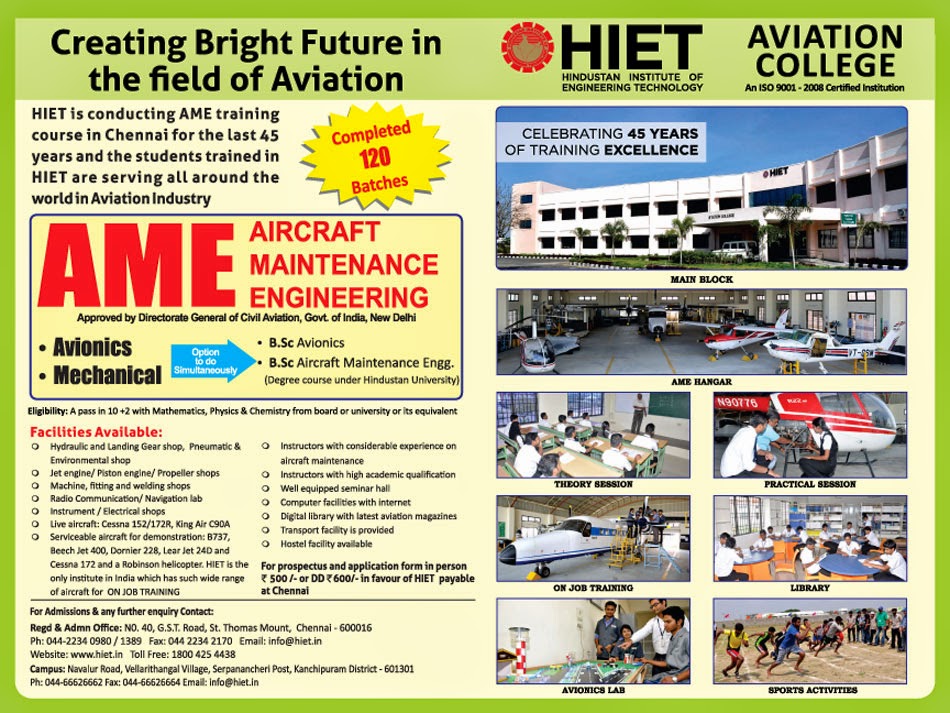
Institutions with long-standing aviation heritage, DGCA-approved AME course structures, dedicated hangar facilities, and consistent industry exposure tend to produce graduates who adapt faster in airline environments. Chennai-based institutes like Hindustan Institute of Engineering Technology (HIET), for instance, operate within an active aviation ecosystem and integrate practical immersion alongside structured AME course details and licensing preparation.
For students serious about aircraft maintenance engineering — not just completing a certificate, but building competence — choosing an environment that prioritises real-world exposure can quietly influence the entire trajectory of an aviation career.